Conflicting KPIs
Two reports measure the same thing and produce different answers.

Enterprise Coherence provides the visibility to understand the enterprise as a connected whole.
ExploreThe difficulty appears later—when individually reasonable decisions no longer fit together.
Strategy points in one direction while processes reinforce another.
Definitions change across business units, systems, and reports.
Metrics reward local success while creating enterprise friction.
Accountability stops at boundaries the work itself crosses.
Technology preserves decisions the business has already moved beyond.
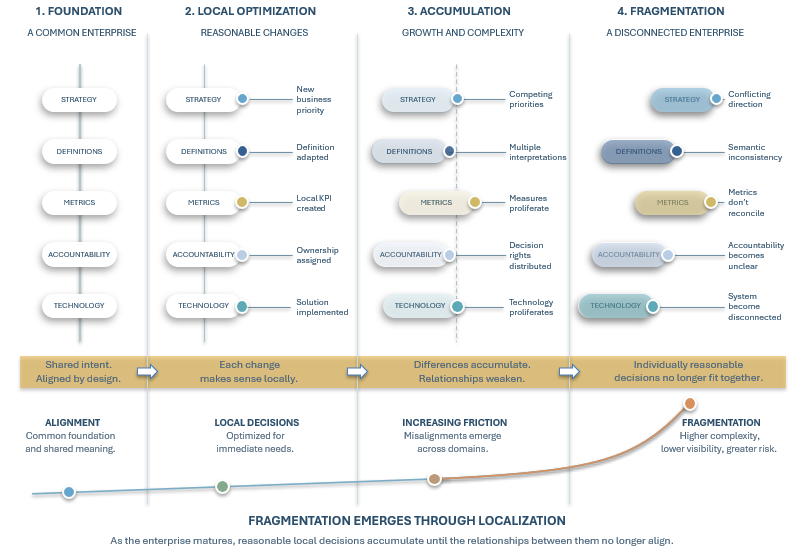
Many problems organizations experience as separate issues may be consequences of relationships that have drifted out of alignment.
Recognize the SignsThe degree to which the essential elements of an enterprise are aligned, connected, and mutually reinforcing in support of business purpose and intent.
Coherence does not mean everything is centralized, standardized, or identical.
It means differences are intentional, understood, and able to work together where the enterprise requires them to.
Explore Enterprise Coherence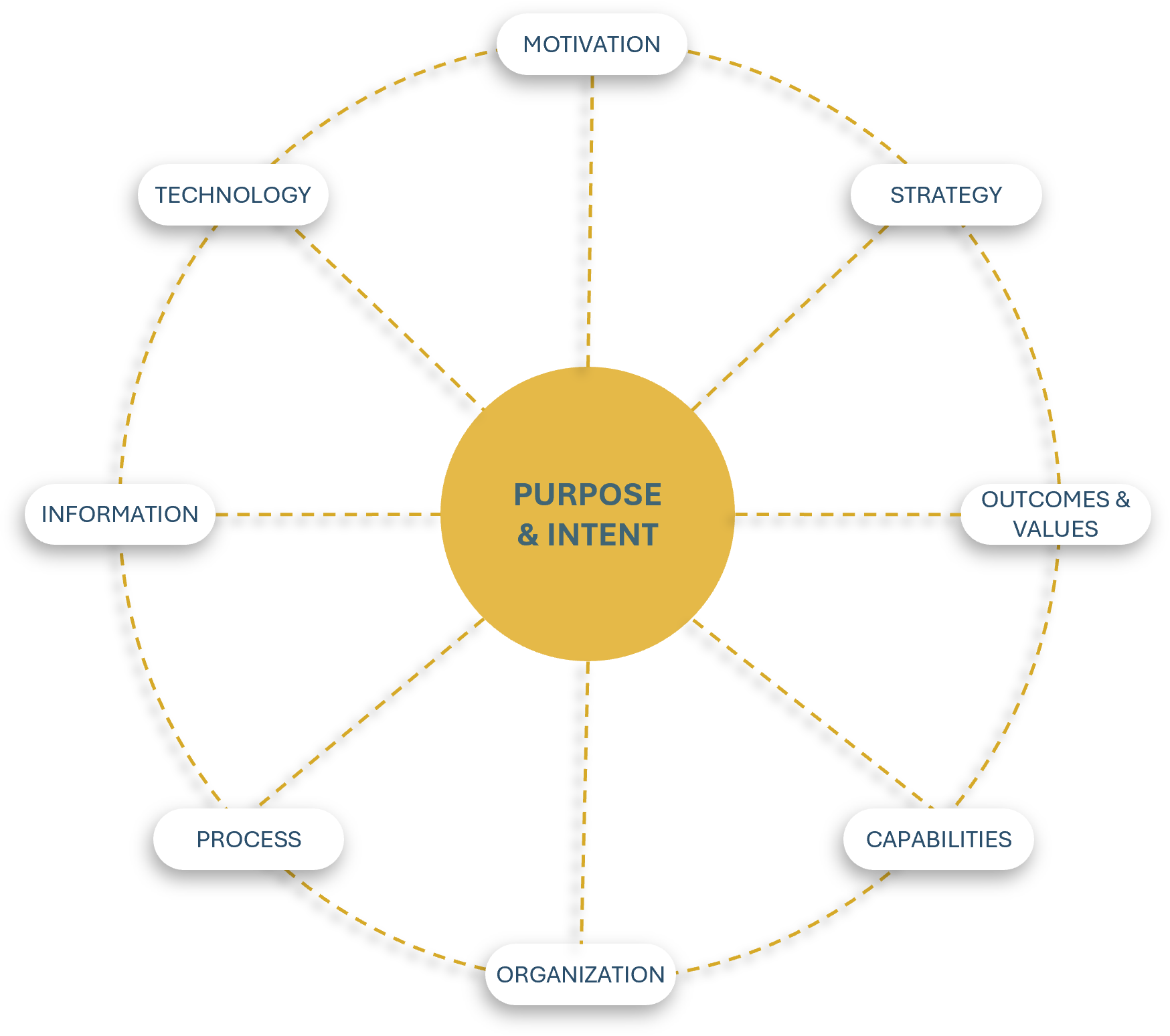
Two reports measure the same thing and produce different answers.
The same business term means different things across functions or systems.
Everyone performs their part, but nobody owns the end-to-end outcome.
Processes, definitions, systems, and decision rights never fully reconnect.
Systems continue reinforcing assumptions the business has moved beyond.
An initiative succeeds in scope while creating friction somewhere else.
Organizations have powerful disciplines for improving individual aspects of the enterprise: strategy, architecture, process, data, governance, technology, change, analytics, and AI.
Each contributes something important. But the enterprise does not experience them separately.
A coherent enterprise does not require every business, region, process, or system to be the same.
The question is whether those differences are:
Coherence is not sameness. It is purposeful alignment.
Decisions are made at different times, by different people, under different circumstances.
Without a way to continually understand the relationships, alignment gradually becomes assumption—and assumption eventually becomes friction.
Illumim does not begin by assuming the answer is another platform, transformation, governance program, architecture exercise, or methodology.
What is the enterprise trying to accomplish?
What must work together for that outcome to happen?
Where are those relationships breaking down?
Where would greater coherence matter most?
The knowledge needed to understand the enterprise often already exists. The difficulty is that it lives in separate places, disciplines, systems, and people.
The Enterprise Blueprint creates a shared, evolving view of the enterprise—from purpose and motivation through strategy, capabilities, operations, information, technology, governance, and outcomes.
It reveals the relationships, dependencies, tensions, and consequences that are difficult to see when each perspective is examined alone.
Enterprise Coherence is not a closed circle and it is not achieved once. The rhythm repeats, but the enterprise does not return to where it began.
Each cycle carries forward what the enterprise has learned. As visibility, judgment, alignment, and adaptive capacity strengthen, the enterprise can operate at a higher level of coherence maturity.
Continuous improvement becomes forward movement—not repeated rediscovery.
Viewed from the front, the rhythm appears circular. Viewed through time, it becomes a rising helix: recurring phases moving the enterprise forward as coherence matures.
Enterprise Actualization is not a claim of perfection. It is the progressive ability of an enterprise to realize its purpose, perform as a connected whole, and adapt without losing coherence.
The objective is not to eliminate every difference. It is to strengthen the relationships that matter most to enterprise purpose and performance.
Every strategy cycle, transformation, acquisition, technology implementation, and organizational change creates new knowledge about how the enterprise works.
Too often, that knowledge becomes fragmented across presentations, repositories, systems, teams, and people. When the next change begins, much of the enterprise must be understood again.
Illumim takes a different view.
The understanding created through improvement should become part of the enterprise's evolving intelligence. Strategy should retain its relationship to capabilities. Capabilities to processes. Processes to information. Information to technology. Technology to architecture. Architecture to decisions. Measures to outcomes. Change to the assumptions and relationships it affects.
As the enterprise evolves, those connections should evolve with it.
Greater Enterprise Coherence creates the possibility of a more connected, accessible, and continuously evolving understanding of the enterprise.
Not by searching dozens of disconnected repositories.
Because the enterprise has progressively developed a connected understanding of itself.
The more the enterprise understands its own relationships, the more intelligently people—and eventually autonomous agents—can reason about change.
An AI agent does not act only within a technology environment.
It acts within an enterprise context: objectives, definitions, processes, decision rights, policies, responsibilities, metrics, controls, technology, and human expectations.
An agent can operate exactly as designed and still produce an outcome the enterprise did not intend.
Trusted autonomous action depends on a sufficiently coherent enterprise context.
Trusted data is not the same as trusted action.
Why local optimization can create enterprise friction.
What inconsistent measures can reveal about the enterprise.
Illumim is an enterprise advisory company focused on helping organizations improve business performance through Enterprise Coherence.
Strategy. Architecture. Data. Governance. Process. Operating models. Technology. Analytics. Transformation. AI.
These disciplines remain important.
But enterprises do not experience them separately.
Illumim focuses on the relationships between them—because enterprise performance is determined not only by the strength of the parts, but by how coherently those parts work together.
Start with the condition you are trying to understand—not with a predefined solution.
You do not need to know whether the issue is “Enterprise Coherence.” That is part of the conversation.